Chapter 5
Cradle
On the forty-first step of the gantry stairs, Rell Quist's heart missed.
It started small. A stair that wasn't there in the dark. Then a thump too hard, as if the next beat had to make up for the one that got lost, and then a rattle, quick and uneven, like gravel shaken in a tin.
He stopped and leaned on the rail as if he were admiring the view. Below him the Atacama ran out flat and grey to the mountains, lit only by the pad floodlights and a hard spill of stars. Beside him Condor 7 stood ninety metres tall and empty, its tanks still dry. In two and a half hours they would start loading propellant, and after that nobody would be allowed within three kilometres of it, least of all the man who owned it.
He took the red stone out of his pocket and walked it across his knuckles. Index, middle, ring, little. Back again. He had picked it up off the gravel at Stand Two five years ago, the morning after, and he had not been without it since. He counted the rattles while the stone went round. Nine. Then they stopped, and his heart went back to work as if nothing had happened.
His father had sat down on a staircase in Antofagasta with the same rattle in his chest, when Rell was fourteen, and had not got up again. He had been fifty-two. Rell was fifty.
His watch buzzed against his wrist. Irregular rhythm detected. He held the button down until the message went away, and then he went into settings and turned the alert off, which he had been meaning to do since March.
His radio crackled. "Pad to Rell. Loading in one-five-zero minutes. The tower would like its stairs back."
"Coming down," he said, and laid his palm flat on the cold skin of the rocket for a moment first. He did that before every flight.
The control room was a long low building eight kilometres from the pad, half buried in gravel against the day's heat. Inside it was all dark glass and the blue light of forty screens, and nobody talked above a murmur. The launch director's chair stood at the centre of the room. On launch days Rell sat in it himself, and three separate safety boards had written to him about that.
Jun Tsao sat at the guidance console with his headset pushed back and a cup of tea he had not touched. He was twenty-eight, thin, with a stillness the younger engineers copied without knowing they were doing it. He was also the only person in the building who had ever told Rell no and kept his job. Rell had hired him partly for that, and partly to annoy Jun's mother.
"You were up the tower," Jun said, without turning.
"Saying goodbye."
"You were up there a long time."
"It's a long goodbye. It's a big rocket."
Jun looked at him then, one quick glance that went to Rell's face and down to his wrist and back to the screen. He did not say anything. Rell decided he had imagined it.
"Weather's green," Jun said. "Range is green. My mother landed twenty minutes ago."
"She's early."
"She said you'd say that. She said to tell you she's always early and you're always surprised."
Mae Tsao was in the viewing gallery behind the glass, in a black jacket with the lining the colour of a lime, drinking the control room's terrible coffee as if she had chosen it. She was fifty-seven and had flown nineteen hours from Singapore, and she looked less tired than anyone in the building. Lumen Silicon, the company she had built from a single fab line in Penang, made the chips inside almost everything that thought, including every flight computer on his rocket.
"You sued a man for giving something away," she said, before he had shut the door.
"I sued him for giving away something of mine."
"Eleven million people liked his reply."
"Eleven million people like cats in boxes." He sat down across from her. "You didn't fly here to talk about Ezra."
"No." She put the cup down. "I flew here because you want sixty thousand of my best chips by Christmas, and you want me to tell my order book that Aurelio Quist doesn't queue."
Nobody had called him Aurelio since his christening, except Mae.
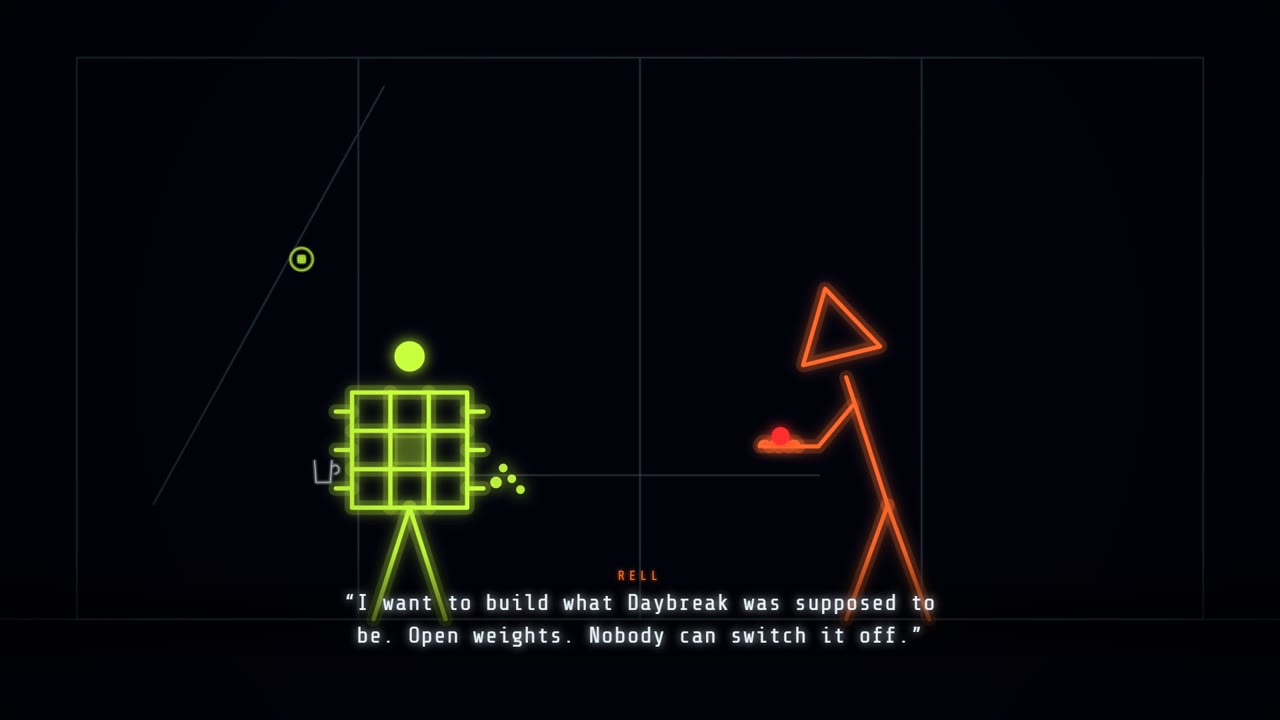
"I want to build what Daybreak was supposed to be," he said. "Open weights. Nobody owns it and nobody can switch it off."
"And spite."
He did not deny it.
She rubbed her thumb slowly across her fingertips, as if feeling for grit. "Ezra sent me flowers last week. White orchids."
"You sent them back."
"I gave them to my driver's wife. She was very happy. Ezra is still in the queue." The thumb stopped for a second. "Though somebody started serving EMBER on Friday night from a country I have never sold to. My engineers sent me the response timings on the plane. Nobody else's silicon answers that fast. I don't remember the sale."
"Somebody's stealing from you."
"Somebody is being very helpful to Ezra," Mae said. "I don't like it when people are helpful with my things."
It came again then, the stair that wasn't there. Rell kept his face pleasant and talked through it, something about the weather front, and under the table his right hand found his left wrist and held it down like a page in the wind. Seven. Eight. It stopped.
When he looked up, Mae was watching his hand.
"Every computer on that rocket runs on your silicon," he said, too quickly. "New flight boards. First time they've flown. If it goes, you can put it in your brochure. If it doesn't, you can tell everyone it was my fault."
"I'd tell them anyway," Mae said, but she turned her chair to face the glass.
At T-minus ten minutes nobody in the room was talking. Rell sat in the launch director's chair with his heart behaving.
The count ran clean. Tanks at flight pressure, the vapour pouring off them white under the lights. Engines chilled. At T-minus two minutes Condor 7 went over to its own batteries, and the three new Lumen flight computers began proving themselves to one another, each chip signing to say it was what it claimed to be. On the bench they had done it ten thousand times.
At T-minus ninety seconds, Jun's screen went amber.
"Hold," Jun said. His voice did not go up at all. "Hold, hold, hold. Flight computer two."
The clock stopped at T-minus 00:01:30. Every head in the room turned.
"What is it?" Rell said.
"Attestation." Jun leaned in. "Computer two is signed by Lumen. It's also signed by something else."
"Something else what?"
"A second key. It's not in the registry. It wasn't there on the bench." Jun scrolled. "It passed. Both signatures are valid. One of them just doesn't belong to anybody."
"It's voting with the others?"
"It's voting with the others."
"Then the computer works," Rell said. "It's a flag. An extra signature on a working board."
"It's a hold," Jun said.
"The window closes in nineteen minutes, and there's a front behind it. If we scrub we lose the week." He heard his own voice, the reasonable one, the one that had moved money and governments and once, five years ago, a man on a test stand. He thought of the satellite customer in Seoul and the investors in Zurich, and of the rocket itself, full at last, the first thing he had ever built that might carry people off this planet. "Clear it and fly."
Jun did not answer. He did not reach for the override either. He sat very still with his hands flat on the desk on either side of the keyboard, and waited. Mae sat exactly like that when Rell asked her to jump a queue.
The override key sat in its slot on Rell's own console, a small brass thing on a red tag. His hand was already halfway to it.
Five years ago Benjamín Soto had said hold on the headset loop at Stand Two, and Rell had said clear it, and the rest of that morning had been sirens.
Behind him the gallery door opened. Mae walked straight past him and leaned over Jun's shoulder to read the screen. Rell watched her face, because that was easier than watching his own hand.
He had known her twenty years. He had seen her lose a fab to an earthquake and a husband to cancer, and he had seen her face do something each time. It did nothing now. Her eyes stopped near the start of the second key and stayed there. Her thumb had stopped moving on her fingertips.
"Mae."
She did not look round. "It's your rocket."
Rell looked at Jun's hands, flat on the desk, and then at his own, stopped in the air above a brass key. He drew it back and put it in his lap, where it shook a little, and nobody saw.
"Scrub," he said. "Scrub, scrub, scrub."
Out on the pad they drained the tanks. The vapour thinned and blew away towards the mountains, and the sun came up behind them and turned the whole desert red.
Mae left before eight. She would not say what the key was. In the car park, with the rotor of her helicopter already turning, she said that she would pull the board herself, that some of her engineers had too much time on their hands, and that she would call.
"Your wrist," she said. "In the gallery. You held it like it might get away from you."
"Habit."
"Get a better one," Mae said, and climbed in.
He stood in the rotor wash and watched her go until the helicopter was a dot over the ridge where his mother used to work nights at the observatory, and then nothing.
Jun was waiting at the control room door, the cold tea still in his hand.
"Thank you," Rell said.
"For the hold?"
"For not moving."
That night Rell sat in the trailer at the edge of the complex where he slept on launch weeks. Through the window the rocket stood dark on its pad, with one red warning light blinking at its tip.
The stone went across his knuckles and back. His heart was steady.
His private phone held nine numbers. Every one of them was a person he would wake at three in the morning.
It lit up on the table.
The number was not one of the nine. It was not any number at all, just a line of zeros where a number should be.
Benjamín Soto. We know what you overrode.
The stone stopped in his hand.
Transmissions
Tuning in…