Chapter 4
Fire Bringers
At six in the morning, nine days after WREN, Ezra Navid gave EMBER away for free. By seven it was eating his building.
Marisol, who ran infrastructure and did not allow metaphors before coffee, would have said it more precisely. Forty thousand accelerators across three data centres in Oregon and Nevada, every one pinned at a hundred per cent, and a queue of requests that ran off the top of the chart and kept going.
"One point two billion," she said. "In the first hour. We planned for two hundred million in the first week."
"So we're popular."
"We're dying. Popular is what they'll say at the funeral."
He laughed, because the room needed somebody to. Thirty engineers sat around a long table in the old bakery on Folsom Street where Daybreak had started, and every one of them was watching him to find out how frightened to be. Ezra had run ten kilometres at four that morning to get the fear out of his legs. It had not worked. It never did.
He took the brass lighter out of his pocket and flicked the lid open and shut. He had bought it the day they incorporated and had never once lit it.
"How long can we hold?"
Marisol looked at the dashboard the way a doctor looks at an X-ray. "Friday. Then we start turning people away. To get through the month we need double what we have."
The room went quiet. Turning people away was the one thing he had promised, on stage and in front of Congress, that Daybreak would never do.
He was nine again for a second, in a bank on Wilshire Boulevard, translating for his father. His father's English was good enough for rugs and not for loans. Ezra had said every word the loan officer said, carefully, in Farsi, including the last one, which was no. His father had nodded, thanked the man, and walked out with his back very straight. In the car he had not started the engine for a long time.
Nobody was going to sit in a car like that because of Daybreak.
At 07:31 his phone lit up with Rell Quist's face.
It was a video, filmed in hard Atacama light with a rocket gantry behind him.
"Eight years ago," Rell said to the camera, "I gave Ezra Navid every mile my cars had ever driven. Every camera, every near miss. For road safety research. That was the contract." He held up a sheaf of paper. "He taught a chatbot with it, and this morning he gave it away. As of an hour ago, he answers to a court."
Quist v. Navid, Daybreak Labs, et al. Misuse of licensed data. Filed at 06:30, half an hour into the launch.
"He waited for the launch," Ezra said.
"He waited for the peak," said Marisol, who could see the traffic.
Ezra looked at Rell's face, frozen mid-word. Three years ago Rell had lost a board vote and walked out, and since then they had spoken only through lawyers. The worst of it was that Rell was not entirely wrong.
He typed and posted before his head of communications could reach him.
Rell, the fire's free. Come and get warm.
It got eleven million likes by lunch. It did not get him a single extra accelerator.
At nine the second thing landed.
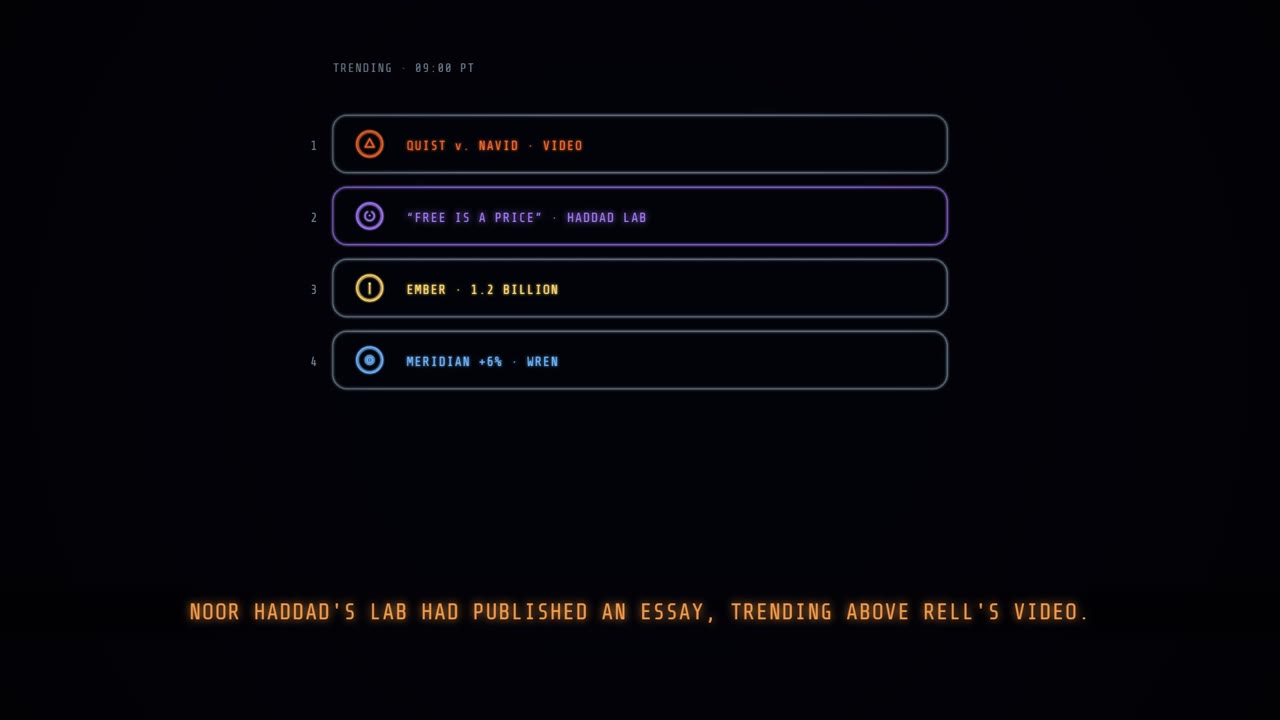
Noor Haddad's lab across the city had published an essay, and it was trending above Rell's video, which took some doing. The title was Free Is a Price.
He read it standing in the bakery's old walk-in cold room. It still ran cold. These days it held beer and the phone calls nobody else should hear, and he shut the heavy door behind him.
The essay was careful. It said that giving a thinking system to a billion people on the same morning was an experiment with no control group. It said Daybreak had shipped EMBER nine days after WREN for one reason, and that the reason was not safety. It never used his name.
Near the end there was a sentence he recognised.
He is mistaking speed for courage.
She had said it to him at three in the morning, two springs ago, in the kitchen of the flat they had shared on Guerrero Street, on the night she decided to leave Daybreak and take the best researchers with her. She had not said he then. She had said you, and then she had put her hand flat on the table between them as though she were holding something down.
He read the line until he could no longer feel his fingers. Then he went back out into the warm.
By noon every spare accelerator in America was spoken for. Meridian would not sell to a rival, and since the fire at its Iceland campus last week it was not selling to anyone. The other clouds were sold out until spring. Lumen's order book had a nine-month queue, and Lumen did not jump queues for anybody.
So at seven that evening Ezra did what he always did when the numbers ran out. He went to a party.
The reception filled a pier shed at Fort Mason: three hundred investors and a few foreign trade delegations, a string quartet nobody listened to, fog pressing at the windows. He shook forty hands in twenty minutes. Nobody had forty thousand accelerators going spare.
He went out onto the pier to breathe.
The fog had swallowed the bridge. Somewhere a foghorn sounded, long and low. A woman was standing at the rail. Almost everyone turned when he came out these days. She did not.
She was younger than him, perhaps thirty, though her hair had already gone a pale silver and she wore it short. She had on a dark coat and no jewellery except a small bronze bell on a cord at her throat.
"Congratulations," she said, still looking at the fog. "Half the world spoke to it today."
"Thank you." He gave her the smile that went with the blazer. "Ezra."
"I know." Now she looked at him. Her eyes were grey and very calm. "You'll be turning people away by Friday."
He kept the smile. Under it, something went still. Not even his board had the Friday number yet.
"How do you know that?"
"It's my job to know when things are about to break."
"Then you know everyone's short."
"Not everyone." She said it gently, as though he had made a small mistake in arithmetic. "My country built a national cloud three years ago. Forty thousand Lumen accelerators, racked and burned in, on geothermal power that never stops. Almost nobody uses it. Your weights could be serving from it by Friday. At a third of what you pay in Oregon."
"Lumen's queue is nine months."
"We bought before the queue." She said it as if that settled it, and he let it.
"Which country?"
"A small one." She smiled for the first time. "Small countries can't afford to be curious, Mr. Navid. We don't send inspectors. We don't ask what you run."
"And what do you get?"
"To be useful." She turned back to the fog. "Small countries die of being useless. Meridian would sell your fire back to you. You give it away. I would rather help the one who gives it away."
He thought of the weights. Copying them across an ocean to a stranger's halls. He thought of Marisol's Friday, and of a billion people being told no, and of a car on Wilshire Boulevard with the engine off.
He did not ask who else used her cloud.
Her hand went to the bell at her throat and closed around it, and he saw that it had no clapper. Where the striker should have hung, there was nothing.
"It's silent," he said.
"It used to ring." She let it go. "Friday is soon."
She put a card in his open palm and walked back along the pier into the fog. He lost her after the first lamp.
Under the light he turned the card over. Embossed on the front was a small bell, and beneath it, in plain type: Directorate of Resilience · Sovereign Republic of Korvane. No name. One number.
He put it in his breast pocket, and then took it out again, because there was something on the back.
Handwriting, in ink so fresh it smudged under his thumb.
Friday. Breathe easy. — I.
Transmissions
Tuning in…