Chapter 3
Tide Tables
The song was still in her mouth when the staff bus dropped her in Keflavík. She had been humming it under her breath for forty minutes without meaning to, and she only noticed when she stopped.
The man from Meridian security was waiting outside her building, and he had brought pastries.
"Hollis," he said, and held out the bag. "Cinnamon, from the airport. The woman said they were the good ones."
He was American, fiftyish and soft-spoken, with his lanyard tucked inside his jacket so it wouldn't flap. Ayla took a pastry because refusing would have meant a conversation about refusing. Closed incidents, in her experience, did not come with a man who had flown in and brought pastries. They stood on the pavement in the endless evening light while gulls worked the bins.
"I won't keep you," Hollis said. "You've had a long two days. I just need to close out a couple of things." He took out a tablet. "Your report was very clear, thank you. You understand the incident is closed?"
"A battery fault."
"A battery fault." He smiled as though they had agreed about the weather. "And you've seen the confidentiality notice. Nothing about the campus or the fire, to anyone, anywhere."
"Yes."
"One more thing, and it's a silly one." He scrolled. "The plumbing contractor's camera system had a disk failure this morning. Total loss, apparently. Old hardware. Gunnar mentioned you'd been on their portal after the fire. I just need to ask whether you downloaded or copied anything from it. For the record."
The pastry was warm in her hand. In her coat pocket, her phone held eleven seconds of video she had filmed off the console screen the morning before, the way you photograph a timetable in case the board goes blank.
"No," Ayla said.
"Not on your phone, even? People film screens."
"No."
He looked at her for a beat longer than the question needed. Then he tapped the tablet. "Great. That's everything. Get some sleep, Ms. Torrin. And honestly, what you did with that breaker took something."
He walked to a grey car and drove away. She stood on the pavement until it turned the corner. Then she went upstairs, locked the door and, after thinking about it, wedged a chair under the handle, which she had never done in four years of living there.
Her flat was one room and a kitchen, with a window that looked west over the harbour. She pulled the blind, which in July only turned the room a dim gold.
She played the eleven seconds once. The diver at the foot of the ladder, the case on its chest, the face turned up to the lens. The hand. The water closing over it.
Then she copied the clip onto an old memory card from the kitchen drawer and taped the card inside the back cover of her mother's almanac, under the endpaper, where the glue had already lifted.
Then she did what she did every year on the fourteenth of July, a day late. She took out the writing paper.
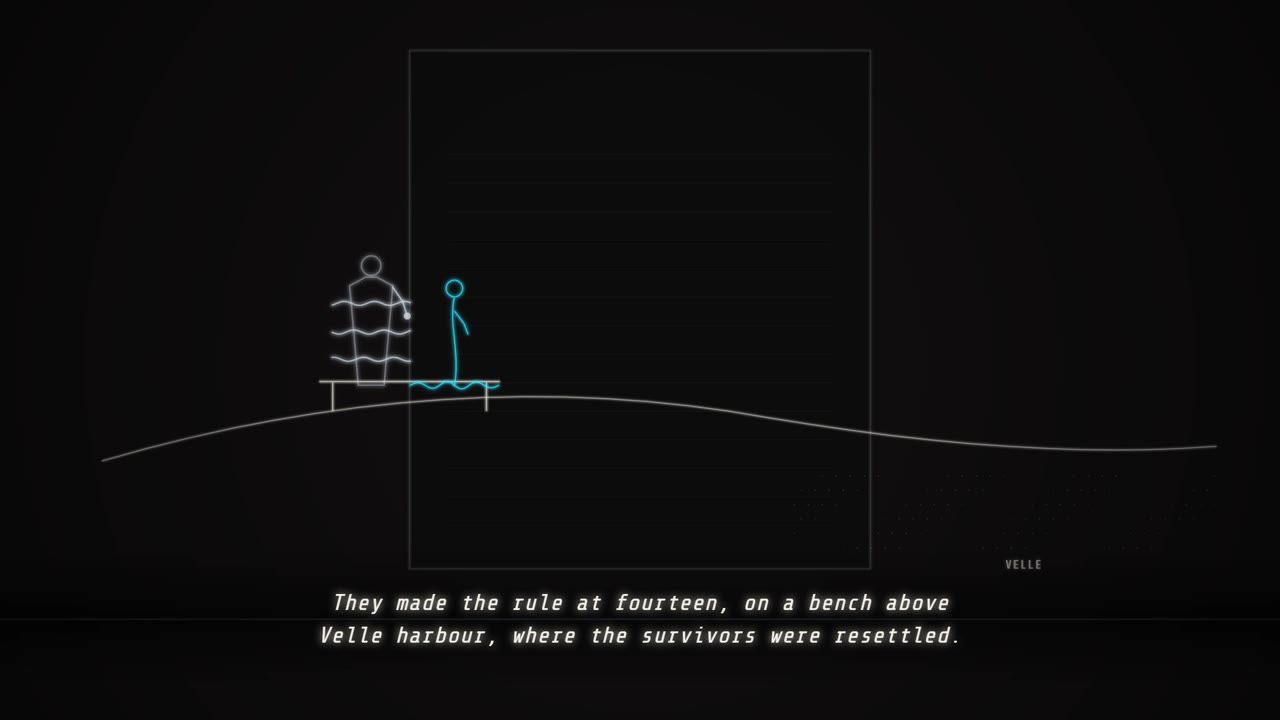
They had made the rule at fourteen, on a bench above Velle harbour, where the government had resettled the survivors: one letter a year, on paper, on the day, whatever happened. Ilse had said paper was harder to lie on. Ayla had thought that was a very grown-up thing to say. Ilse had been sixteen.
Dear Ilse, she wrote, and then sat for a long time with the pen above the page.
The song was in her mouth again. She closed it.
She was seven, and the water was in the street.
It came down out of the valley where the dam was and filled the town from the bottom up, black and fast and carrying things: a bicycle, a door, a cow turning slowly. The power was already gone. The only light came from the bell tower of the harbour church, where someone had a torch.
Her mother had been holding her hand, and then she wasn't.
Ilse Varo was nine and lived three doors down and could recite the month's tide table from memory, which the fishermen paid her in sweets to do. It was Ilse who pulled her out of the doorway and up the church steps, through the little door to the tower stair, and up and up to the roof under the bell. The tower shook. Every time the water hit the wall the bell rang by itself, with no one pulling it, a great bruised note that went through Ayla's teeth.
Ilse tied them both to the bell rope with her school scarf. Then she put her mouth against Ayla's ear and sang, under the roar, the bedtime song every mother on their street knew, the one that went down and waited and climbed.
"Breathe when I squeeze," Ilse said, and squeezed. "In, four. Hold, four. Don't breathe when the water says. Breathe when I say."
They were on that roof for nine hours. When the helicopters came, the street had gone, and the church's lower floors, and everyone in the two houses between Ilse's door and Ayla's.
Forty-one thousand people across the city, the inquiry said later. The harbour quarter that sang that song lay under eleven metres of silt. Perhaps a few thousand people alive still knew the words, and Ayla had not heard any of them sing it outside her grandmother's kitchen in twenty years.
Until this morning, from a speaker in Iceland, in a machine's voice.
She found that she had pressed the pen so hard into the paper that it had gone through to the desk.
She put the pen down and picked up her phone.
On the night of the fire she had not let herself check the minute. She checked it now. The city was gone, but the sea in front of it kept time.
14 July 2029 · Ostra Sound · High water 03:12 UTC.
The fire alarm in Hall 4 had gone off at 03:12. On the fourteenth of July, twenty years to the night.
Coincidence, she told herself, in the voice Gunnar used for the word nominal.
She wrote nothing about it to Ilse. She wrote about Gunnar's crossword and the strange, beautiful launch, and about being thanked by a chief executive and given nothing else, and glad of it. She did not write about the fire. She had promised Hollis. And something older than the promise, something she did not look at directly, did not want Ilse to know where she had been at three in the morning.
She signed it and folded it, and was pressing the envelope shut when her phone buzzed on the table.
A message, from a number she had saved years ago and never once used, because that was the rule.
You're late this year, little sister.
The letter was still on the table, unsent.
The phone buzzed again.
I heard you walked into the smoke for them. Did you breathe the way I taught you on the roof?
Ayla went through it the way she would go through a fault tree. The radio had said no one was hurt. She had told no one. Gunnar knew, and the fire crews, and they did not know Ilse. Everyone else who knew had read her report: a security director in California, Hollis, Priya Ilangovan.
And one more branch, the one she would not follow. Someone else had been inside Hall 4 with her that night. Someone who had come up out of the sea.
She typed with her thumb before she could stop herself. Who told you?
Sent.
The answer came almost at once.
Don't do it again. They aren't worth your breath.
Transmissions
Tuning in…